Orchids are UFOs

I’ll tell you a secret: orchids are UFOs. They are. I mean it.

Maroon striped orchid. Photo by Andrée Fredette

I accidentally walked into an orchid show at the Hilton in Portland, a couple of weeks ago. These photos are but a sampling of the extraordinary array of … exotic flowers I saw that day.

Yellow UFO orchid. Photo by Andrée Fredette

What a stunning room!

I took pictures with my phone, because my camera’s memory card was full. Duh.

Hot pink cattleya orchid. Photo by Andrée Fredette

I spent a lot of time on my knees, trying to get close-up shots of these extraordinary flowers. Orchids really are UFOs of the plant world.

Orchid copper close up. Photo by Andrée Fredette

Frankly, some of their shapes are almost menacing. The copper one above almost looks like… a monster from a sci-fi movie. Aliens?

Orchid with stripes. Photo by Andrée Fredetet

This striped one, above, is not reassuring either.


Orchid with markings. Photo by Andrée Fredette

This pink one with exotic markings was more “conventional”, and almost resembled a pansy. Maybe.


White blushing orchid. Photo by Andrée Fredette

And I am going to close this post with a “blushing” white orchid, exquisitely shaped.

I really regret not getting the full ID information on these unusual plants. But there you are. If you are interested, you can get in touch with your local orchid society. Those people will be happy to share their knowledge with you.

Punk Deer

This post could also be titled “When deer go bad.”

Black-tailed deer, browsing a flowering tree. Photo by Andrée Fredette

This pretty much explains why all the trees on this island have a “tutu skirt”, at about saddle height.

See the three “action shots” taken with a phone through my window on a grey day, below. Not very crisp, I admit, but they show a determined black-tailed deer, springing up to “box” at a Garry oak branch until the vibration brings it within reach…

Deer and Garry Oak 1. Photo by Andrée Fredette

Get ready, set, jump.

Deer and Garry Oak 2. Photo by Andrée Fredette

And grasp, and pull. The whole tree was shaking. Impressive ripping.

Deer and Garry Oak 3. Photo by Andrée Fredette

No predators means an overabundant population of black-tailed deer in the Southern Gulf Islands, and Southern Vancouver Island, including Victoria’s suburbs… and even downtown.

This means that gardens and any special specimen tree or shrub must be fenced. And by fenced, I mean gulag-style, at least 6 to 8 feet tall. Otherwise, vegetation gets grazed practically to lawn level. Not fenced like in the photo below:

Camas Lilies at Fort Rodd Hill Park. Photo: Parks Canada

This picture of young people admiring camas lilies, was taken (not by me) at Fort Rodd Hill, in Victoria. While it is well-intended, it is laughable.

Note the mini-fence, designed to keep people off the flowers in a Garry Oak meadow. The deer would have no problem mowing these plants down. Someone must be guarding those flowers from dusk to morning, because meadow flowers are part of the deer buffet.

I have a Garry Oak meadow in front of my house: it looks like a golf green. In ten years, I only occasionally got a glimpse of camas lilies and other wildflowers. Only a glimpse, mind you. They were rapidly erased by our four-legged friends.

Final part of my rant: new trees don’t stand a chance. Inside my garden fence, which was installed three summers ago, I have spotted little Garry oaks popping up under the parent tree. Little arbutus (or madrone, in the US) are also coming up.  These trees are valued because this is the northern part of their habitat, a habitat that is being degraded. I repeat: outside a fenced area, saplings don’t stand a chance.

In forest clearings around here, young firs and cedars are browsed into little pitiful stumpy things about two feet high…

Deer cull: two four-letter words.

It’s not that I don’t like them. It’s just that I like them in reasonable numbers.

Trio of black-tailed deer, East Point, Saturna Island. Photo © Andrée Fredette

Xeriscape Choices – Photo Wednesday

My rock garden is blooming and abuzz with hummingbirds and bees. The birds and the bees, it must be spring!

Our side of the island is very dry in summer, and my plant choices reflect that. The little rock roses (Cistacea) I bought several years ago now dwarf the bird bath (note to self: move bird batch into a “clearing” to provide a better landing strip for my winged friends).  Here is the first bloom, so papery and delicate, it just sings of spring… Both of my rock roses are covered with buds, so there will soon be a symphony.

Rock rose (Cistacea), first bloom of the season. Photo © Andrée Fredette

Good thing that I like succulents, because it makes dry gardening much easier. Their textures are very interesting and I have built quite the collection, both of the kind that can make it through our winter, and the kind that must come indoors during the wet and cold months. The latter are arranged in containers (photos in another post soon).

Below, a close-up of hens and chicks (Sempervivum tectorum) and another delicate one whose name I have forgotten (it blooms delicately in white).

Xeriscape with succulents. Photo © Andrée Fredette

And then, the other tough plants that can stand the dry time, and survive our winters: the Spanish lavenders (Lavandula stoechas).

Spanish lavender (Lavandula stoechas), mature plant in lilac. Photo © Andrée Fredette

These early-blooming lavenders have taken over the job of keeping the bees entertained from the rosemary bushes and are abuzz with activity. When I walk into the garden, the buzzing is very noticeable. Bees and others love, love, love the Spanish lavenders right now.

Spanish lavender (Lavandula stoechas) in lilac. Photo © Andrée Fredette

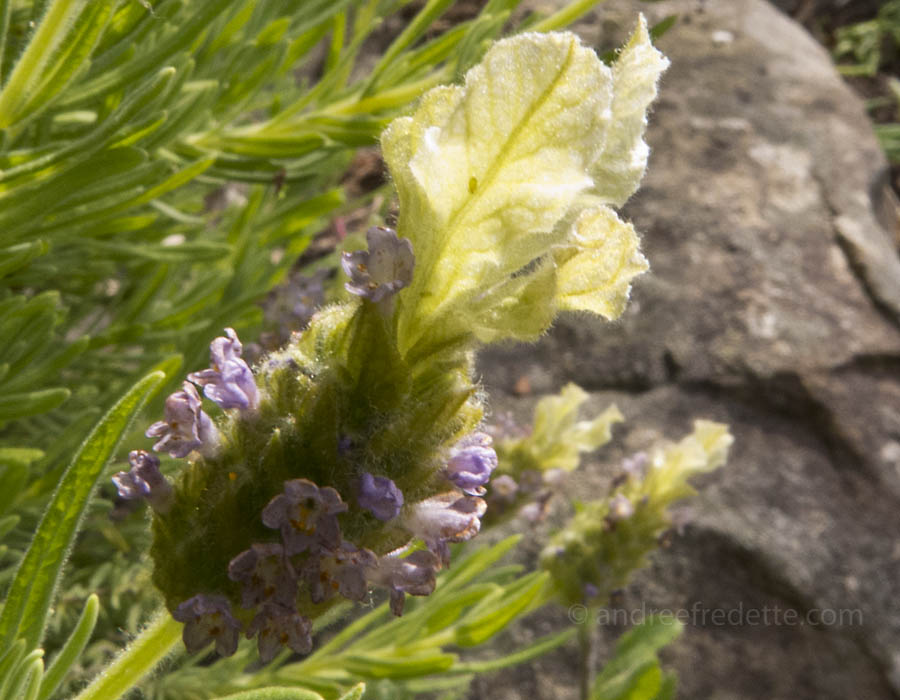
Above, a lilac version.  I also have a really dark purple one, and somehow, these two have self-hybridized in the garden and produced this new version below, all white wings with little lilac blooms… Some of the junior plants are half-lilac and half-white.

Spanish lavender (Lavandula stoechas) in white hybrid. Photo © Andrée Fredette

I completely approve of plants that reproduce in my garden, and come up with new “jazz” versions.

Quilts and Photography