Category Archives: Just Because

Xeriscape Choices – Photo Wednesday

My rock garden is blooming and abuzz with hummingbirds and bees. The birds and the bees, it must be spring!

Our side of the island is very dry in summer, and my plant choices reflect that. The little rock roses (Cistacea) I bought several years ago now dwarf the bird bath (note to self: move bird batch into a “clearing” to provide a better landing strip for my winged friends).  Here is the first bloom, so papery and delicate, it just sings of spring… Both of my rock roses are covered with buds, so there will soon be a symphony.

Rock rose (Cistacea), first bloom of the season. Photo © Andrée Fredette

Good thing that I like succulents, because it makes dry gardening much easier. Their textures are very interesting and I have built quite the collection, both of the kind that can make it through our winter, and the kind that must come indoors during the wet and cold months. The latter are arranged in containers (photos in another post soon).

Below, a close-up of hens and chicks (Sempervivum tectorum) and another delicate one whose name I have forgotten (it blooms delicately in white).

Xeriscape with succulents. Photo © Andrée Fredette

And then, the other tough plants that can stand the dry time, and survive our winters: the Spanish lavenders (Lavandula stoechas).

Spanish lavender (Lavandula stoechas), mature plant in lilac. Photo © Andrée Fredette

These early-blooming lavenders have taken over the job of keeping the bees entertained from the rosemary bushes and are abuzz with activity. When I walk into the garden, the buzzing is very noticeable. Bees and others love, love, love the Spanish lavenders right now.

Spanish lavender (Lavandula stoechas) in lilac. Photo © Andrée Fredette

Above, a lilac version.  I also have a really dark purple one, and somehow, these two have self-hybridized in the garden and produced this new version below, all white wings with little lilac blooms… Some of the junior plants are half-lilac and half-white.
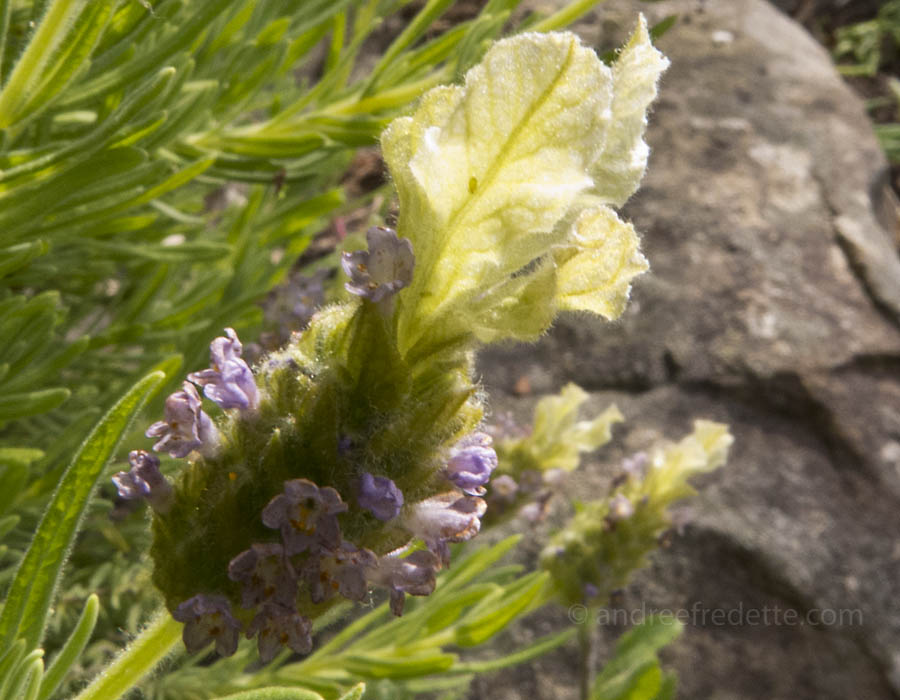
Spanish lavender (Lavandula stoechas) in white hybrid. Photo © Andrée Fredette

I completely approve of plants that reproduce in my garden, and come up with new “jazz” versions.
A flower, for a sunny Friday

I was going to write a longer post in the series I started, about texturing quilts… but it’s a sunny day and the garden is calling me.

So instead, I am offering you a photo of Mount St. Helens last week, when the cloud cover briefly lifted and revealed the caldera and the meandering outflow in the valley below. Spectacular scenery!

Mount St. Helens, April 2015. Photo © Andrée Fredette

On the hills below the volcano, the wildflowers were everywhere…

Indian Paintbrush, Abstracted. Photo © Andrée Fredette

Here is a digitally-manipulated version of Indian Paintbrush (Castilleja), one of those abundant wildflowers below Mount St. Helens last week, in Washington. And now, back outside in the sunny Pacific Northwest…

Southern sea creatures in Seattle

On a grey and rainy day in Seattle, a visit to the Seattle Aquarium means entering a world of exuberant colours. A carnival of textures, particularly in the Southern Pacific section of the Aquarium…
Southern Pacific anemone. Photo © Andrée Fredette

I admit that I was lazy and did not write down the names of these critters, anemones, and corals. I just feasted on their looks.
Southern Pacific soft coral. © Andrée Fredette

The corals (or are they anemones?) are spectacularly beautiful.  Luminescent, almost. Their texture is very inspiring for a textile artist.

Souther Pacific coral. Photo © Andrée Fredette

Here is another example of coral – which looks a lot like a group of anemones but is not, apparently.

Giant clam mantle. Photo © Andrée Fredette
And this riot of lines is the mantle of a giant clam. I spent a good deal of time admiring its markings, a recipe for drawing lines.  The underwater world is a great source of inspiration on the use of colour, contrast, and line.

Oh, and at the top of this post, the Lionfish (Pterois) is my “over the top” poster version of this very dangerous, venomous creature. This is a fish that offers plenty of warning…

In the same tank, I spotted its cousin, the Clearfin Lionfish (Pterois radiata) on a side wall. I caught a slightly out of focus shot of it, below.

Clearfin Lionfish. Photo © Andrée Fredette

Lines, lines everywhere. Some lines as a form of come hither, some lines as forms of serious warning. And colour, naturally.

Carousel – Photo Wednesday

Mini-road trips are fun.
Carousel at the Seattle Waterfront. Photo © Andrée Fredette
After visiting the Seattle aquarium, next door, we wandered along the waterfront. At the foot of the big wheel, we discovered this  gorgeous old school carousel. It’s described like this: “…an original hand carved carousel from the early 20th century. It is one of the oldest working carousels in North America…”

Did you know that there were several styles of carousels in the US alone?

In the United States, the carousel industry was developed by immigrants, notably Gustav Dentzel of Germany and Dare from England, from the late 19th century. Several centers and styles for the construction of carousels emerged in the United States: Coney Island style – characterized by elaborate, and sometimes faux-jeweled, saddles – with Charles I. D. Looff; Philadelphia style – known for more realistically painted saddles – with Dentzel and the Philadelphia Toboggan Company; and Country Fair style – often with no saddles at all – with Allan Herschell and Edward Spillman of western New York, and Charles W. Parker of Kansas. The golden age of the carousel in America was the early 20th century, with large machines and elaborate animals, chariots, and decorations being built.

Here is a photo of a carousel horse, decorated in the Coney Island style, taken by Peter Greenberg:

Coney Island Style Carousel Horse, Photo by Peter Greenberg

Want to see more? Check out the slide show of the “Carousel of the Month, April 2015” (as chosen by the National Carousel Association), a 1902 Herschell-Spillman Carousel still in operation in Ocean City, Maryland. An outstanding menagerie of creatures, beautifully sculpted and painted.