Tag Archives: Photography

Artistry and Craftsmanship

Going through my photos of old trips, finding forgotten beauty…

Among my pictures, I found this detail shot of the exquisite ironwork on a door of the Portail de la Vierge, at the Notre-Dame cathedral, in Paris.

Detail of the carving, main doors, Notre Dame de Paris cathedral. Photo by Andrée Fredette

Ironwork so exquisite took a great deal of time to make. Small, detailed pieces were painstakingly forged, then assembled into complex motifs, which were then attached to the doors.  This dates back to the XIth or XIIth century…

Below, a drawing of the ironwork of the Sainte-Anne door – an example of the extremely complex assembly of the smaller branches. Drawing by E.Guillaumot, in Dictionnaire raisonné de l’architecture française du XIe au XVIe siècle, by Eugène Viollet-le-Duc, 1856.

Ironwork, Sainte-Anne door, Notre-Dame de Paris Cathedral.


And inside the building, there are treasures of architecture everywhere. Also, the gaze goes up…

The North Transet Rose at Notre-Dame de Paris. Photo by Oliver Mitchell.Photo by Oliver Mitchell

Above, the north transept rose window of Notre-Dame de Paris. The window was installed c. 1250-60 when Jean de Chelles was architect. It features the Virgin and Child enthroned in the centre, surrounded by images of kings and Old Testament prophets.

Beautiful details everywhere.

Below, an additional detail photo of the door that started this post. This time the photo is by Myrabella. Great detail shot!

Detail shot of the Portail de la Vierge, Notre-Dame de Paris catthedral. Photo by Myrabella.

And I am going to finish with the legend  of Biscornet, the young blacksmith who was asked to created the ironwork for two of the doors of the cathedral:

According to legend, it was the 13th-century ironsmith Biscornet who designed the intricate metalwork that adorns the side-doors of Notre Dame. Biscornet was young and ambitious, but, as the story goes, he was so overwhelmed by the momentousness of his task that he made a deal with the Devil – offering him his soul in return for help with the commission.

“Well, I am the Devil after all,” replied the demon officiously. “If you sign a contract with me, I will make of you the most skilled of all metalworkers, and you will be able to create all the magnificent works you please.”

And so Biscornet worked and worked, day after day, until one morning he was found asleep in front of his completed masterpiece. The magnificent doors bore witness to the young ironsmith’s remarkable finesse. Alas, however, on the day of the doors’ inauguration, they refused to open. Only when they were dashed with holy water would they finally budge, and Biscornet was absolved from his demonic pact.

The central doors, conversely, were never originally ornamented – a fact that surprised even Victor Hugo, whose Notre Dame de Paris became the most famous work of literature on the cathedral. Not until the 19th-century restoration by Viollet-Le-Duc did the ironsmith Boulanger finally add some metal detail to them – only after restoring the cursed doors of Biscornet, of course. — Translation by Tim McInerney

There is always a good story to go with exceptional artwork, don’t you think?


Boat Pass Hunter: A little drama

During the winter, all kinds of waterfowl spend the winter in the waters around these islands. Here is the story of a little drama I got to witness, a while ago.

The setting: Boat Pass, between Saturna and Samuel Islands. When the tide moves in or out at Boat Pass, the current moves swiftly, like rapids…


Boat pass, between Saturna and Samuel Islands. Photo by Andrée Fredette

That day, on the strait side of Boat Pass (to the right, in the above photo),  rafts of surf scoter ducks were floating about, feeding on the fish coming through with the tidal current. Rows upon rows of them, taking turns at diving – when at the front line – to feed. Very orderly system…


Surf scoter ducks in "raft" formation, minding their own business. Photo by Andrée FredetteMinding their own business.


The hunter: a sea lion, riding the tide through the pass. Clever sea lion, using the tide to increase his speed and stealth… The only reason I spotted him was his loud breath (I was sitting on a rock, right next to the flow, at water’s edge, and he surprised me. These are really big animals, the size of a cow…).

The Boat Pass hunter: a sea lion, riding the tide through the pass for added speed and stealth. Photo by Andrée Fredette

While in the pass, at speed, he dove…

…and surfaced right in the middle of the birds.

Surf scoter ducks, escaping a predator. Photo by Andrée Fredette

The birds exploded into flight. Well, not quite flight because if you’ve seen surf scoters take off on the water, you’ll know that they need some serious flapping and “walking” on the water to take off. So their escape was not quite successful.

I am going to guess that some unlucky one (or more than one) did not make it… Score one or two for the sea lion.


Surf scoter ducks reform the raft, after the danger has passed. Photo by Andrée Fredette

Once the drama was over, the sea lion could be seen, swimming to the rocks the Belle Isles chain…

And the birds reformed into an interesting shape, and drifted off toward the islets in the distance.

Nothing to see, folks, move along.

Nature Morte

Salal is an evergreen plant that carpets the forest floor in areas where there is an opening in the canopy, and near roads and paths.

It is green, most of the time. Except in the fall, where some of the leaves start to decay and acquire a bit of individuality.


Salal leaf, decaying. Photo by Andrée Fredette

The decay patterns are interesting.


Salal leaf, decaying. Photo by Andrée Fredette

Very individual.


Salal leaf, decaying. Photo by Andrée Fredette


And lacy.

Salal leaf decay, lacy. Photo by Andrée Fredette


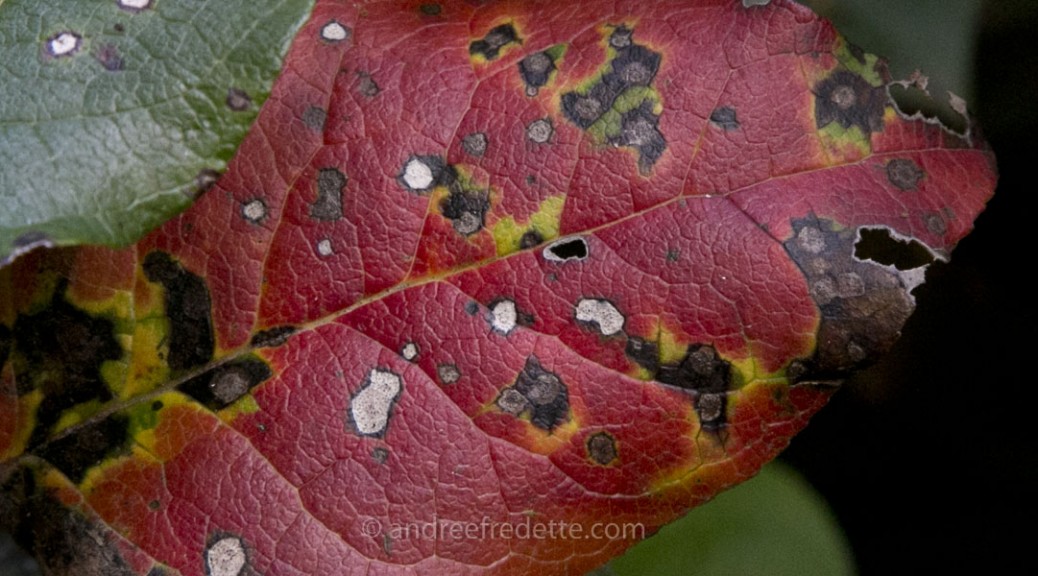
And some go very red, as a final big show…

Salal leaf decay, red. Photo by Andrée Fredette