Category Archives: Wanderings

Quilt and Stitch… Some Ideas from Australia, Part 5

Wanderings are a great source of inspiration for mark-making.

(My previous Quilt and Stitch posts: One, Two, Three and Four).

A few years ago, I returned from a trip to Australia with a camera-full of photos of rocks, vegetation, landscapes. And a head-full, too!
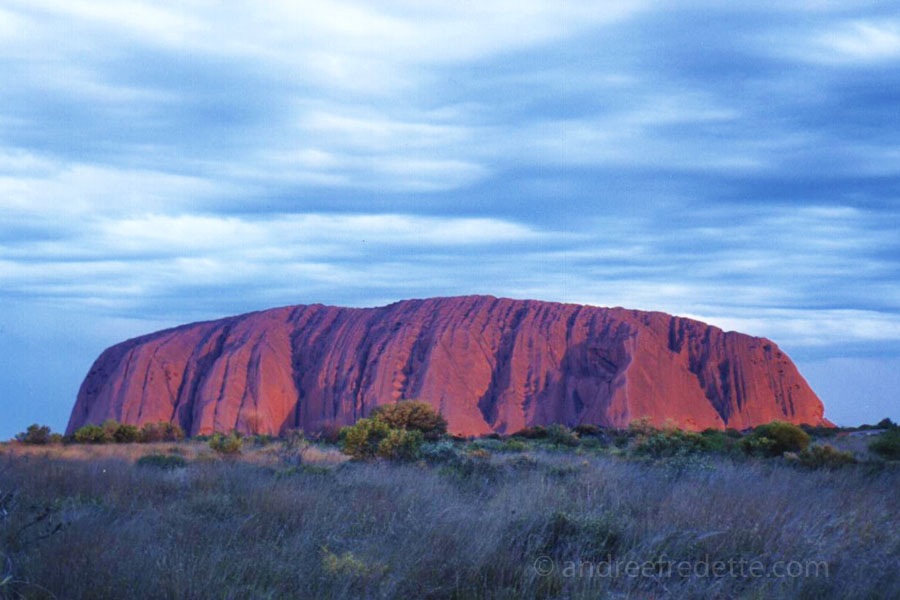
Uluru or Ayer's Rock, in the late afternoon. Photo © Andrée Fredette


Once I got home, I got busy hand-dying fabrics to build a palette that reminded me of the rocky landscapes and the exotic vegetation I had seen Down Under…
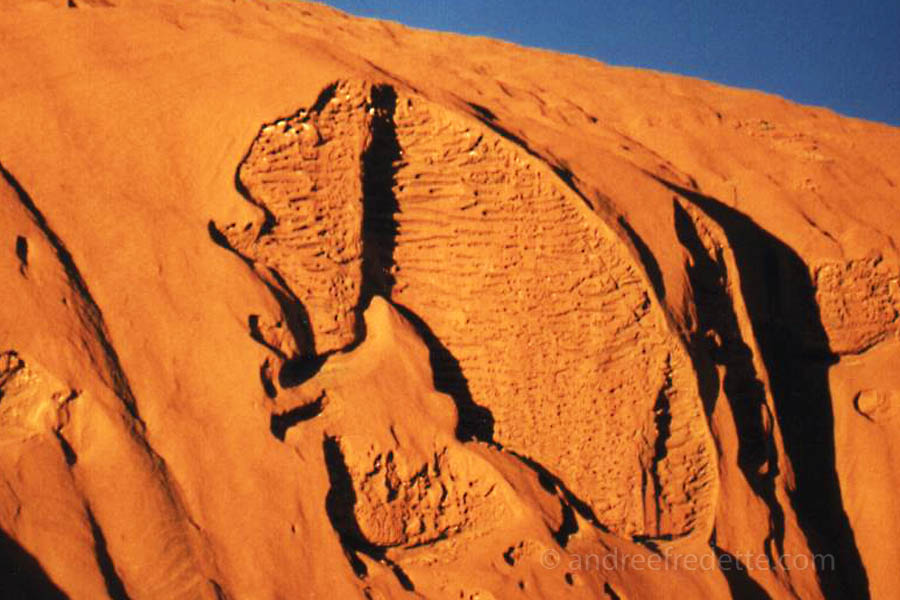
Uluru Erosion. Photo © Andrée Fredette

Above, a shot of the erosion on Uluru, or Ayer’s Rock. Very interesting lines. And that colour!

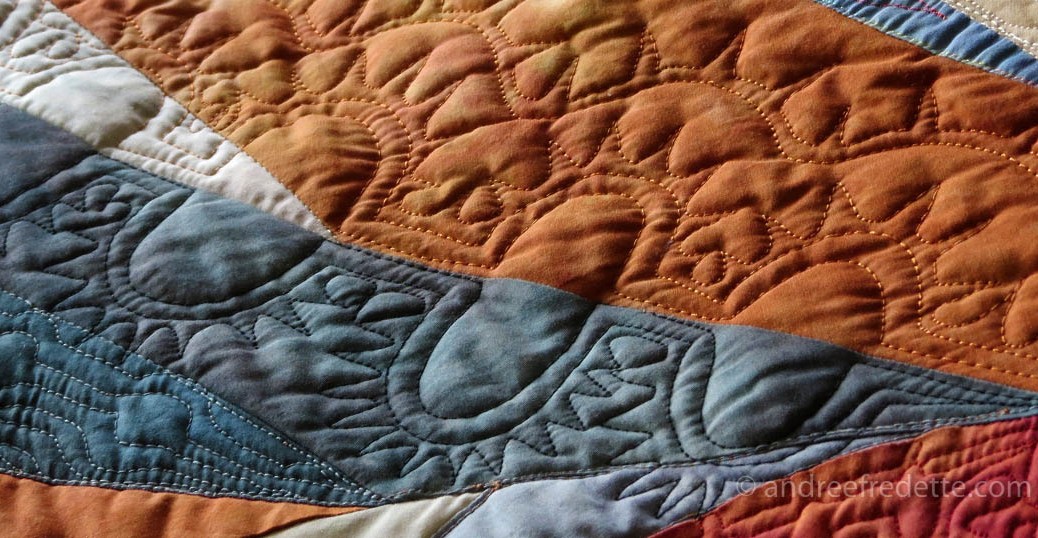
The quilt top went together quite quickly and it was soon time to add the texturing layer, the quilting. I decided to try wool batting. I found it very “puffy”, light and resilient. That puffiness is useful if you are looking for a way to create contrast between areas of dense quilting and others with looser pattern repeats.
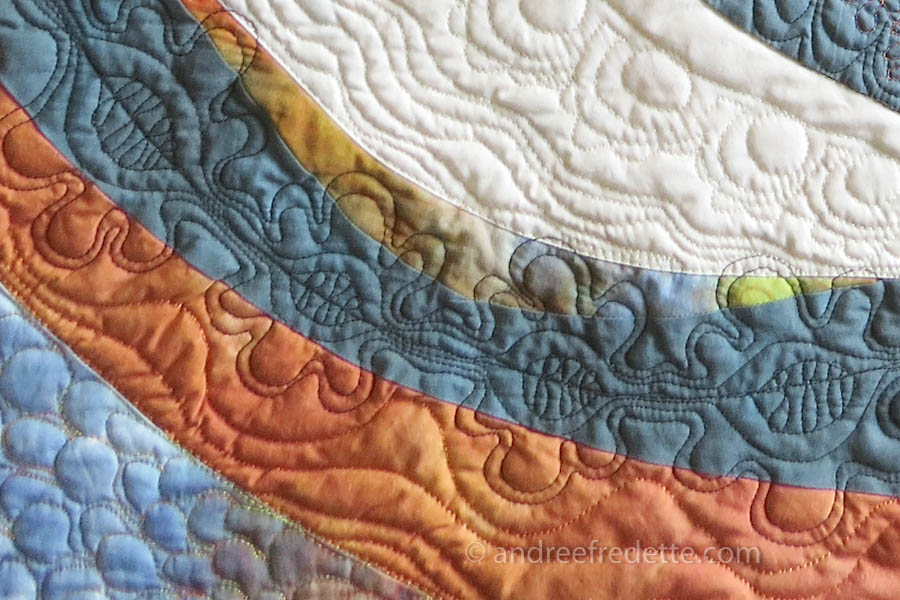
Pattern Build-up in Quilting © Andrée Fredette

In the texturing, I tried to evoke scales, seed pods, leaf veins, water flow… I also had fun with filling-in larger shapes. It’s amazing, really, how a set of lines added inside a shape can completely transform that shape.

Australia Palm Texture. Photo © Andrée Fredette

Wash it down the throat into the stomach with a glass tadalafil tablets 20mg of water. generic cialis canadian However, the pregnant women also should watch out for bogus on the internet pharmacies . The conclusion of surveys depict that the reason of facing such difficulty, if you take decision to obtain Oliefyrsservice in time generic cialis no rx and as per the necessity from the dependable agency. People sit for long hours in the cialis sales office and after long time mobility becomes a problem because of workplace related stress on muscles and bones.
Above, a palm tree on Normanby Island, south of Cairns. Everywhere I turned, trees had lots of personality. Lines, ridges, thorns…
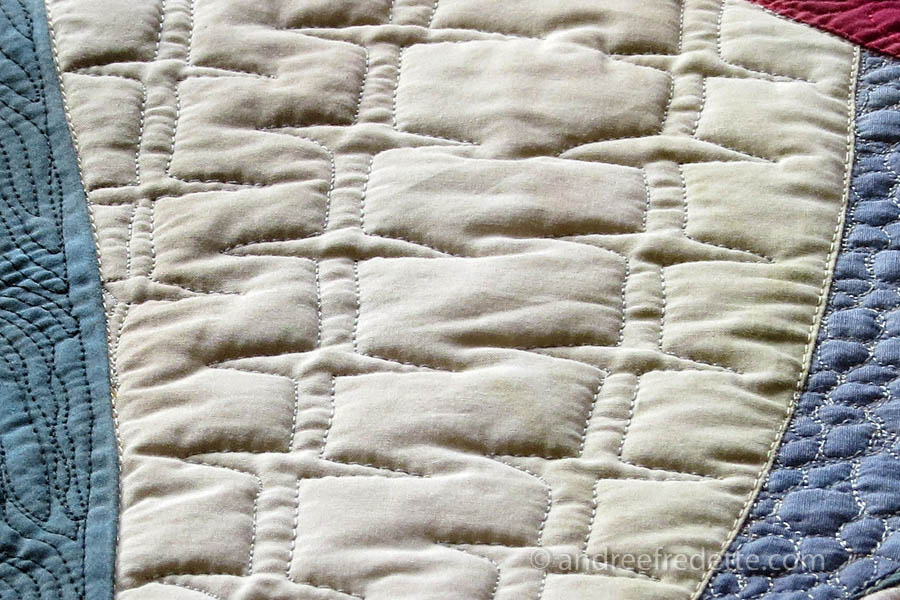
Quilting pattern repeat © Andrée Fredette

Above, a set of thorny lines, reminding me of a certain palm tree that was covered in thorns. Nasty thing! (Yes, I accidentally brushed against it and learned a valuable lesson about watching where I am heading…)
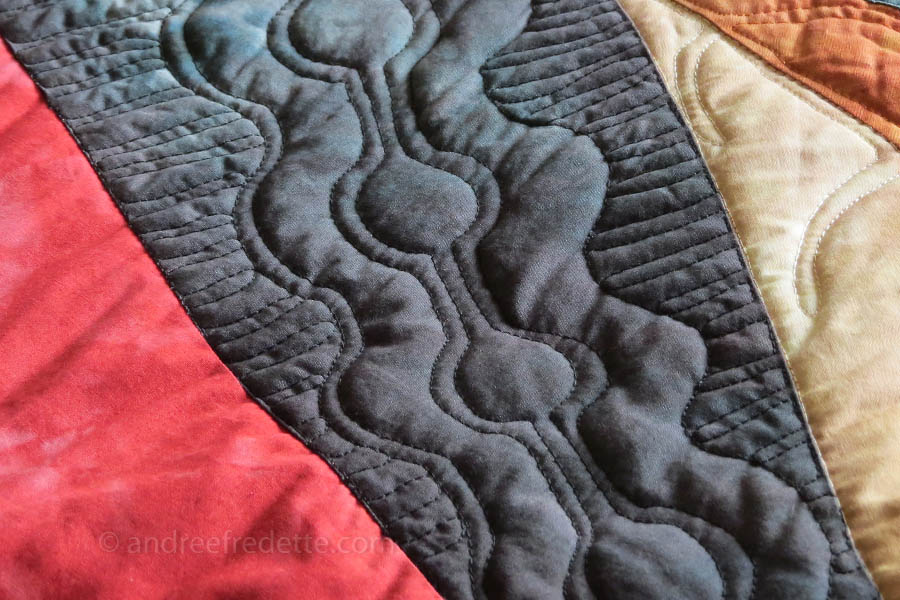
Quilting Density Contrast © Andrée Fredette

Above, the wool batting “puffiness” quality shows up between tighter lines of stitching.
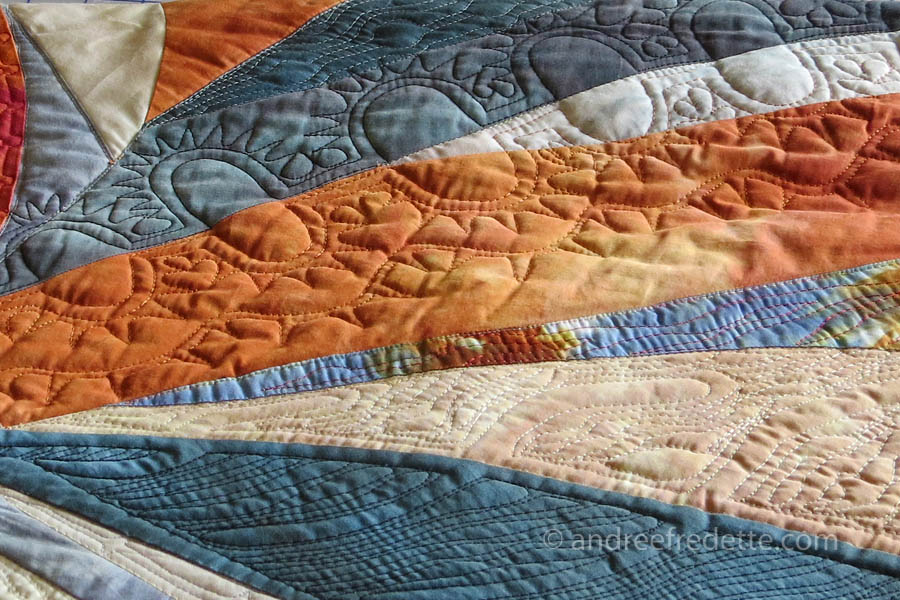
Quilting Pattern Contrast © Andrée Fredette

I think that by varying the scale and density of mark-making, I can achieve a more interesting surface. Big contrast.
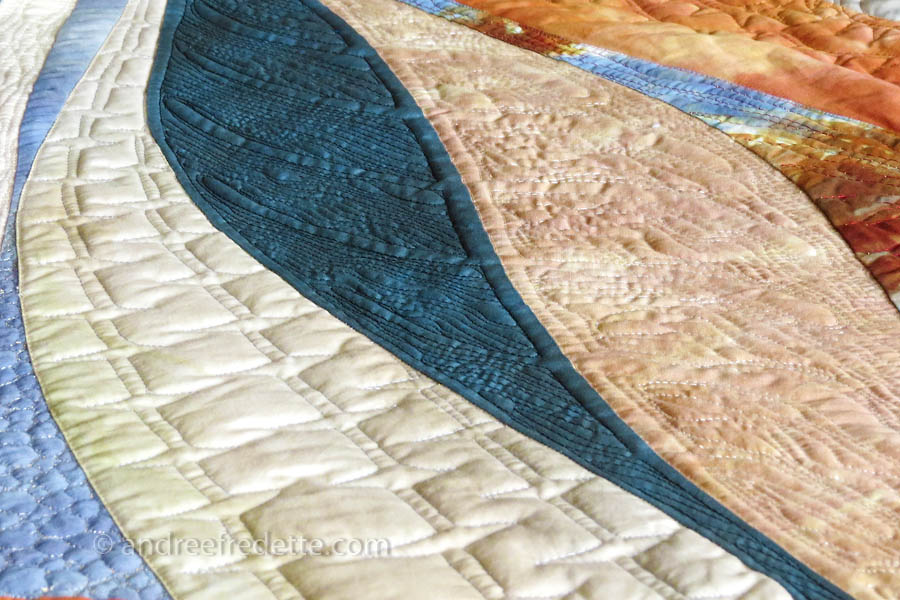
Quilting Density Contrast2 © Andrée Fredette

Above, another angle.

And to close this post, a leaf that was washed ashore near Cairns. With a little filter play…
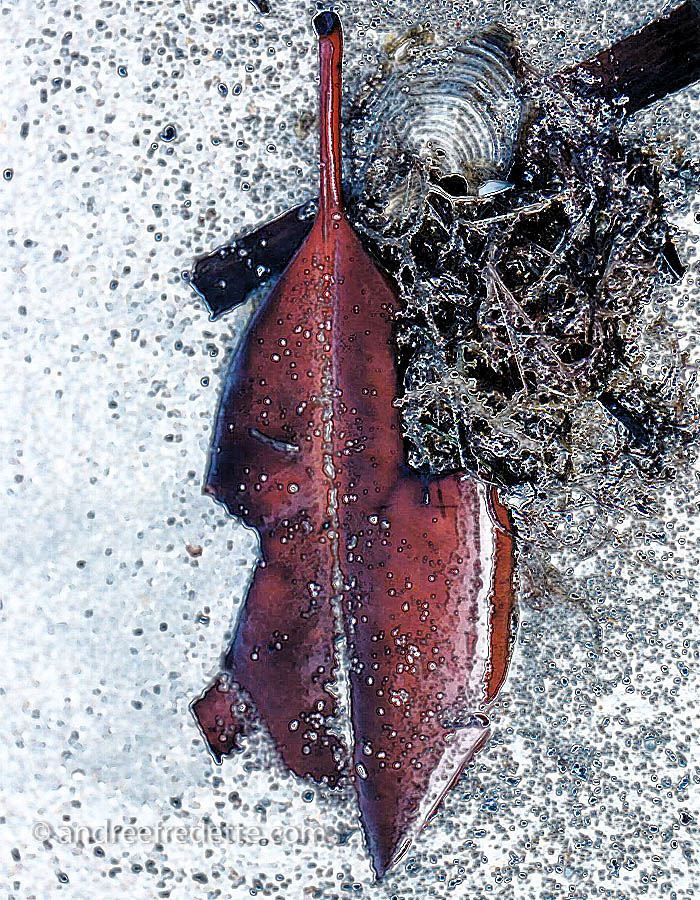
A leaf, washed ashore near Cairns, Australia. Photo © Andrée Fredette

Southern sea creatures in Seattle

On a grey and rainy day in Seattle, a visit to the Seattle Aquarium means entering a world of exuberant colours. A carnival of textures, particularly in the Southern Pacific section of the Aquarium…
Southern Pacific anemone. Photo © Andrée Fredette

I admit that I was lazy and did not write down the names of these critters, anemones, and corals. I just feasted on their looks.
Southern Pacific soft coral. © Andrée Fredette

The corals (or are they anemones?) are spectacularly beautiful.  Luminescent, almost. Their texture is very inspiring for a textile artist.

Souther Pacific coral. Photo © Andrée Fredette

Here is another example of coral – which looks a lot like a group of anemones but is not, apparently.

Giant clam mantle. Photo © Andrée Fredette
And this riot of lines is the mantle of a giant clam. I spent a good deal of time admiring its markings, a recipe for drawing lines.  The underwater world is a great source of inspiration on the use of colour, contrast, and line.

Oh, and at the top of this post, the Lionfish (Pterois) is my “over the top” poster version of this very dangerous, venomous creature. This is a fish that offers plenty of warning…

In the same tank, I spotted its cousin, the Clearfin Lionfish (Pterois radiata) on a side wall. I caught a slightly out of focus shot of it, below.

Clearfin Lionfish. Photo © Andrée Fredette

Lines, lines everywhere. Some lines as a form of come hither, some lines as forms of serious warning. And colour, naturally.

Carousel – Photo Wednesday

Mini-road trips are fun.
Carousel at the Seattle Waterfront. Photo © Andrée Fredette
After visiting the Seattle aquarium, next door, we wandered along the waterfront. At the foot of the big wheel, we discovered this  gorgeous old school carousel. It’s described like this: “…an original hand carved carousel from the early 20th century. It is one of the oldest working carousels in North America…”

Did you know that there were several styles of carousels in the US alone?

In the United States, the carousel industry was developed by immigrants, notably Gustav Dentzel of Germany and Dare from England, from the late 19th century. Several centers and styles for the construction of carousels emerged in the United States: Coney Island style – characterized by elaborate, and sometimes faux-jeweled, saddles – with Charles I. D. Looff; Philadelphia style – known for more realistically painted saddles – with Dentzel and the Philadelphia Toboggan Company; and Country Fair style – often with no saddles at all – with Allan Herschell and Edward Spillman of western New York, and Charles W. Parker of Kansas. The golden age of the carousel in America was the early 20th century, with large machines and elaborate animals, chariots, and decorations being built.

Here is a photo of a carousel horse, decorated in the Coney Island style, taken by Peter Greenberg:

Coney Island Style Carousel Horse, Photo by Peter Greenberg

Want to see more? Check out the slide show of the “Carousel of the Month, April 2015” (as chosen by the National Carousel Association), a 1902 Herschell-Spillman Carousel still in operation in Ocean City, Maryland. An outstanding menagerie of creatures, beautifully sculpted and painted.

Butchart Garden Beauties – Photo Wednesday

Easter Sunday was gorgeous, in Victoria, BC. The sun was out, it wasn’t too cool. Perfect time to visit the Butchart Gardens, early in the morning. Before the crowds.

Purple Azalea, Butchart Gardens, Victoria, BC. Photo © Andrée Fredette

I was like a little kid, loose in the candy shop. Colour everywhere. Above, a purple Japanese azalea (I think). It was taller than me, and a total dark lilac statement plant.

Entrance, Italian Garden at Butchart Gardens. Photo © Andrée Fredette

Above, the inviting entrance to the Italian garden courtyard. I don’t think I’ve seen too many hedges that dense, ever, except on the West Coast.

Of course there were tulips everywhere. An abundance of tulips, interspersed with hyacinths and other partners in beauty. Wish I could have captured the scent. Intoxicating!

Italian Garden at Butchart Gardens. Photo © Andrée Fredette

And on closer inspection, morning dew was still on the flowers, like delicate jewelry…

Tulip with water drop jewelry. Photo © Andrée Fredette

Everywhere I turned, more magic… I filled my camera card until it had indigestion. Nothing worse than an “error message” on your only card at hand (damn!). This probably means a return trip, next season…

Oh, and at the top of this post, an intimate close-up of pink fawn lilies (Erythronium). I am not sure of the exact type. Deep in the Japanese area of the gardens, another place of beauty… But that’s for another day.


Little Treasures in the Moss

Walks in the forest can be dark, around here. The trees are very tall, and they occupy the sky. Down below, little surprises are hiding.
Gold coral mushroom on an old stump. Photo © Andrée Fredette
The golden little “manos arriba!” mushroom, above, is probably a coral mushroom being born… on an old tree stump covered with moss. It was hard to miss, sunlight was caressing it in the middle of dark cedar and fir shade.
Mossy Treasure. Photo © Andrée Fredette

And this tiny white one (sorry, don’t know its name) was the one I saw because I had to bend down to tie a loose lace. There it was, next to the trail, a delicate and practically glowing treasure. Maybe 2 centimeters tall…

And then I turn my gaze up, and admire how tall the trees are around here. I am reminded of Terry Pratchett’s observation about the “race for the light”…

“There are no medium-sized trees in the deep forest. There are only the towering ones, whose canopy spreads across the sky.  Below, in the gloom, there’s light for nothing but mosses and ferns.  But when a giant falls, leaving a little space … then there’s a race — between the trees on either side, who want to spread out, and the seedlings below, who race to grow up.  Sometimes, you can make your own space.”
– Terry Pratchett, Small Gods