Tag Archives: Pacific Northwest

Cool Surfers at Wickaninnish Beach

The days and weeks have been very long since I broke my ankle, on May 31st. Books and Netflix only hold so much magic…

To reset the dial, my daughter took me on a three-day road trip. Off to Vancouver Island, and Port Alberni, Ucluelet and Tofino. And especially, the Pacific Rim National Park… AKA the Wet Coast.

At the top of this post, a very wet me, sitting in the cool beach wheelchair we were able to borrow from the Kwisitis Visitor Centre, at Wickaninnish Beach. The hard sand part of the beach was easier to navigate for my wheelchair-pusher (i.e. daughter), but getting across the soft sand at the top of the beach was another story. We needed help (or I would have had to crawl back), and help was very graciously provided by one of the Centre’s staffers. They spotted our struggling, probably sighed, and came to our rescue. I am grateful.

The sights? Lots of surfers. The beach may look empty, but every dark speck in the waves is a surfer, in full wetsuit.

And then, this young woman and her dog caught my attention…

Surfers at Wickaninnish Beach, Parcific Rim National Park, Vancouver Island, BC. Photo by Andrée Fredette

The dog was beside herself with joy at the open space, the water, the waves, being out there with her “mommy”, and having fun.

The surfer told me that her dog was learning to surf, but “she keeps dumping me when she steps forward”… Working on technique. Aren’t we all?

Surfing Duo, Wickaninnish Beach, Pacific Rim National Park, Vancouver Island, BC. Photo by Andrée Fredette

A few minutes later, looked like they were mastering it very nicely.

Surfing Trio, Wickaninnish Beach. Pacific Rim National Park, Vancouver Island, BC. Photo by Andrée Fredette

Well, then she saw “daddy” and started to step forward to say hello. Looks like this may end up in a tip over…

And I leave you with the suspense.

Did I mention that this was a very wet day?

Droplets, on the Peat Bog Boardwalk. Pacific Rim National Park, Vancouver Island, BC. Photo by Andrée Fredette

We took a stroll (a roll, in my case) on the Peat Bog Boardwalk. It was a very wet day. Very wet.

And on the art side, we stopped at the Eagle Aerie Gallery, and admired the prints, carvings and paintings by Roy Henry Vickers. The gallery, a gorgeous building all in massive carved cedar boards, is a beautiful setting for the art on display. Not to be missed, if you are in Tofino.

Whale Watching?

Every spring, the cycle of whale watching begins anew in the waters around this island. I say cycle, but I could also use the word circus to describe what goes on.

Humpback whales, surrounded. Photo © Andrée Fredette

Over the past few weeks, humpback whales have been going back and forth in Boundary Pass, south of Saturna.

In the photo above, taken May 30 at around 2 p.m., there are two humpback whales (you can spot the back hump of one of them, on the left, close to the big boat). The whales are outnumbered, to say the least…

Whale watchers near Saturna Island, May 30, 2015, 2 pm. Photo © Andrée Fredette

Because there are only two humpback whales instead of a pod of orcas, the numerous boats jockey for position, so that their customers get a good view and/or picture of the whales. The boats are supposed to keep their distance, and not interfere with the path of the animals.

Below is the graphic I got from the Pacific Whale Watching Association (PWWA), illustrating the standards they are supposed to observe. Note that on the Canadian side, we are much more lax than the Americans: boats only have to stay 100 yards away from the whales, instead of 200 yards in US waters.

Pacific Whale Watching Association (PWWA) graphic re. standards

On its guidelines page, the PWWA piously offers the following information:

“The development of these Best Practices (guidelines) have given guests from around the world the ability to learn about wildlife through observation while creating minimal to no impact to the animals. The industry, government and non-governmental organization conservation management model employed in these waters (and initiated by PWWA) is one of the most comprehensive self-management conservation frameworks in the world. It has been proven to be one of the most utilized conservation tools wherever charistmatic, protected megafauna are viewed, and has been presented at the Conference of the North American Committee for Environmental Cooperation (NACEC) attended by the United States, Canada and Mexico.”

Much too close to humpback whales. Photo © Andrée Fredette

“…Minimal to no impact to the animals… Comprehensive self-management?…I beg to differ. The white boat above was constantly trying very hard to stay within the 100 yard margin. Captain got a big tip?

Explorathor whale-watching boat too close to humpback whales, and almost blocking their path. Photo © Andrée Fredette

And one of the Explorathors from Vancouver, above, is idling in the path of the whales, on purpose. Another no-no.

Whale watcher too close, boat ID Explorathor II. Photo © Andrée Fredette

Here are the boats in question. Above, Explorathor II. Below, Explorathor Express.

Whale Watchers too close, boat ID Explorathor Express. Photo  © Andrée Fredette

ID number for the white boat, which was otherwise unidentified: C19967BC.

Whale watchers too close, boat ID C19967BC. Photo  © Andrée Fredette

Tourism is a good thing. Educating the public about wildlife in an engaging and exciting manner is also a good thing. But you also have to treat the object of your interest with respect. Stick to the guidelines.

What exactly is too much of a good thing? How many boats should be allowed to surround two whales, and for how long?

Report any whale or orca harassment, here are the numbers:

In Canada to Fisheries and Oceans Canada
1-800-465-4336
In the U.S. to NOAA Fisheries, Office of Law Enforcement
1-800-853-1964

Seattle Art Museum – Photo Wednesday

The Seattle Art Museum is a treasure trove. A great place to spend an afternoon, and to “travel” the continents, admiring art and artifacts from around the world.  Until May 17, the SAM features Indigenous Beauty, an exquisite special exhibition. Don’t miss it. This post is not about that particular exhibition (because photography was not allowed in that section), but it focuses on the art and artifacts of West Coast  artists from several First Nations.

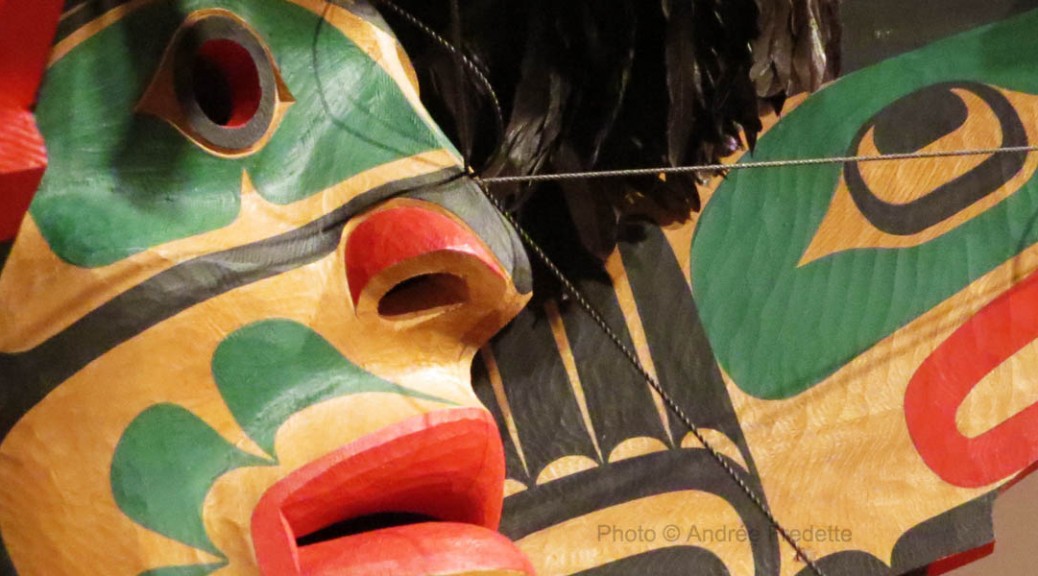
First, a quick description of the very colourful transformation mask pictured above: this is part of a full set of Thunderbird regalia by Calvin Hunt, a Kwakwaka’wakw artist from Fort Rupert (or Tsaxis), on the northern tip of Vancouver Island, BC.
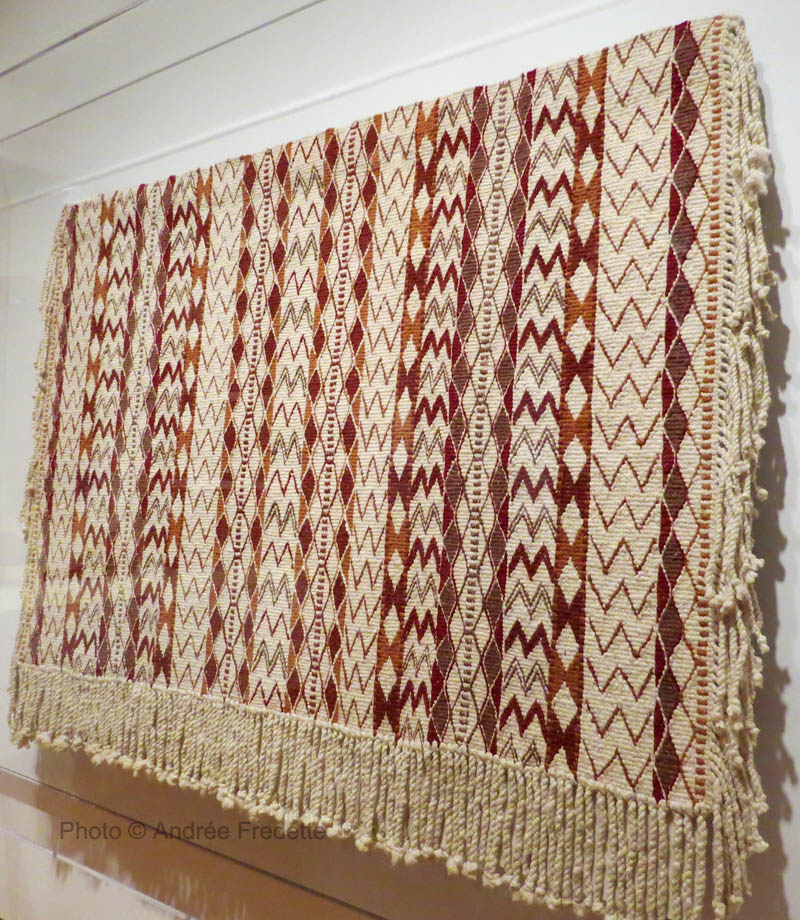
Sacred Change for Each Other. Robe woven by Susan Pavel, adopted Skohomish. Photo © Andrée Fredette

Above, Sacred Change for Each Other,  a blanket woven by Susan Pavel. This American artist is an adopted Skohomish. This is the first Salish mountain goat wool robe to be woven in 100 years, and a gift to the museum in 2007. According to the artist:

“This robe or blanket is more than just a garment: it is a feminine entity that has come forth to bring many teaching. The “Sacred change” refers to the revitalization of Coast Salish cultural practices. The wavy lines and zigzags represent the life force, while the dashes are backbones, reminding us to be strong against life’s challenges.”

On to the powerful work of Susan Point, a remarkable Coast Salish artist of the Musqueam band, in Vancouver, BC, who works in red and yellow cedar, as in the piece below, The First People, but also creates commissions in metal, cast concrete, and so on. Check out her public art pieces for the City of Seattle, on her website. And take a look at her serigraphs, at the Spirit Wrestler Gallery website.

The First People, by Susan Point. Red and yellow cedar. Photo © Andrée Fredette

I closed in for a detail shot, to show the contrast between areas with deliberate tool marks, and the very smooth finish of the faces.

The First People, detail. Susan Point, Coast Salish Musqueam Nation. Photo © Andrée Fredette

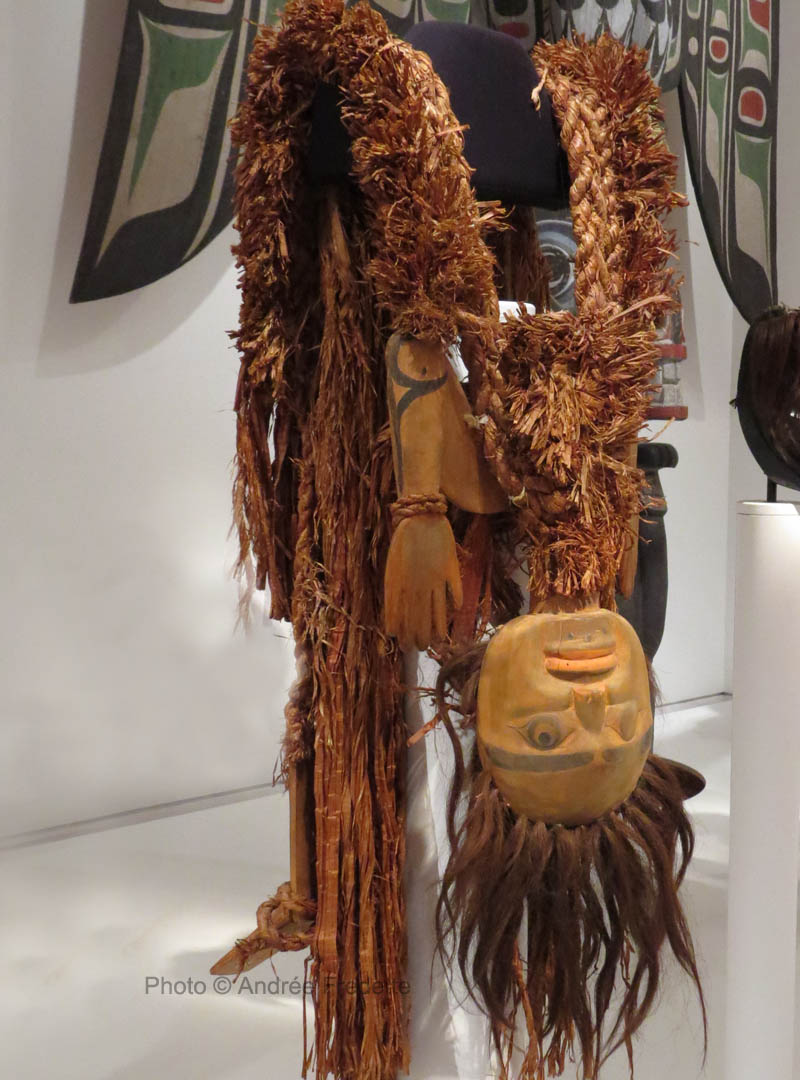
Then, the piece below stopped me in my tracks. Human Being Neck Ring (Bagwikala),  is an accessory for the Kwakwaka’wakw dancer.

Human Neck Ring, ca. 1910, by Mungo Martin or Charlie James. Kwagu'l. Photo © Andrée Fredette

I am very interested in native ceremonial regalia and have admired many masks and accessories for dancers in museums and galleries all over North America. But I have never seen a human being neck ring before. This one was made by Mungo Martin or Charlie James, around 1910. Here is the museum’s description of its meaning:

“Red-dyed cedar bark neck rings are part of the costume of the hamat’sa. As the dancer is progressively tamed, his costume changes from the hemlock bows that he wears when he’s in a wild condition, to red-dyed cedar bark neck rings, arm bands and ankle bands, and eventually to the blanket or robe which he wears in his tame state. Some neck rings have carved figures added. There are only two or three other known examples of neck rings.”

The Hamat’sa is a winter dance, an element of a complex ritual. If you are curious about that ritual, click on this video.

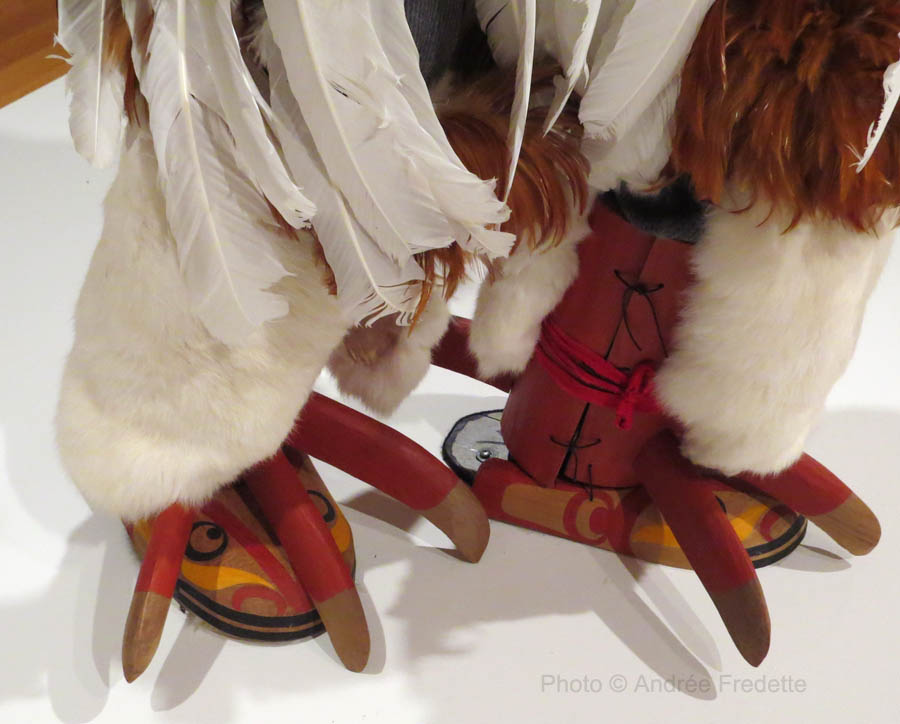
Returning to Calvin Hunt’s dancer’s regalia with which I started the post (mask at the top), the photo below shows the “leggings and toe covers” for the dancer.

Foot and leg pieces for ceremonial dancer, by Calvin Hunt, Canadian Kwagu'l. Photo © Andrée Fredette

Well, I started this post at the head, with a powerful mask by Calvin Hunt, and am finishing it at the feet of the same regalia. Take a minute to reflect on the meaning of these costumes, the investment in time and effort required to create them, traditionally, for those special occasions. And the imagination and beliefs that powered it all.

Little Treasures in the Moss

Walks in the forest can be dark, around here. The trees are very tall, and they occupy the sky. Down below, little surprises are hiding.
Gold coral mushroom on an old stump. Photo © Andrée Fredette
The golden little “manos arriba!” mushroom, above, is probably a coral mushroom being born… on an old tree stump covered with moss. It was hard to miss, sunlight was caressing it in the middle of dark cedar and fir shade.
Mossy Treasure. Photo © Andrée Fredette

And this tiny white one (sorry, don’t know its name) was the one I saw because I had to bend down to tie a loose lace. There it was, next to the trail, a delicate and practically glowing treasure. Maybe 2 centimeters tall…

And then I turn my gaze up, and admire how tall the trees are around here. I am reminded of Terry Pratchett’s observation about the “race for the light”…

“There are no medium-sized trees in the deep forest. There are only the towering ones, whose canopy spreads across the sky.  Below, in the gloom, there’s light for nothing but mosses and ferns.  But when a giant falls, leaving a little space … then there’s a race — between the trees on either side, who want to spread out, and the seedlings below, who race to grow up.  Sometimes, you can make your own space.”
– Terry Pratchett, Small Gods