Jungle, one of my larger quilts, was acquired by a collector this week. She sent me a photo and tells me that she and her partner are both very happy with this new addition to their collection.

Jungle, one of my larger quilts, was acquired by a collector this week. She sent me a photo and tells me that she and her partner are both very happy with this new addition to their collection.
The Seattle Art Museum is a treasure trove. A great place to spend an afternoon, and to “travel” the continents, admiring art and artifacts from around the world. Until May 17, the SAM features Indigenous Beauty, an exquisite special exhibition. Don’t miss it. This post is not about that particular exhibition (because photography was not allowed in that section), but it focuses on the art and artifacts of West Coast artists from several First Nations.
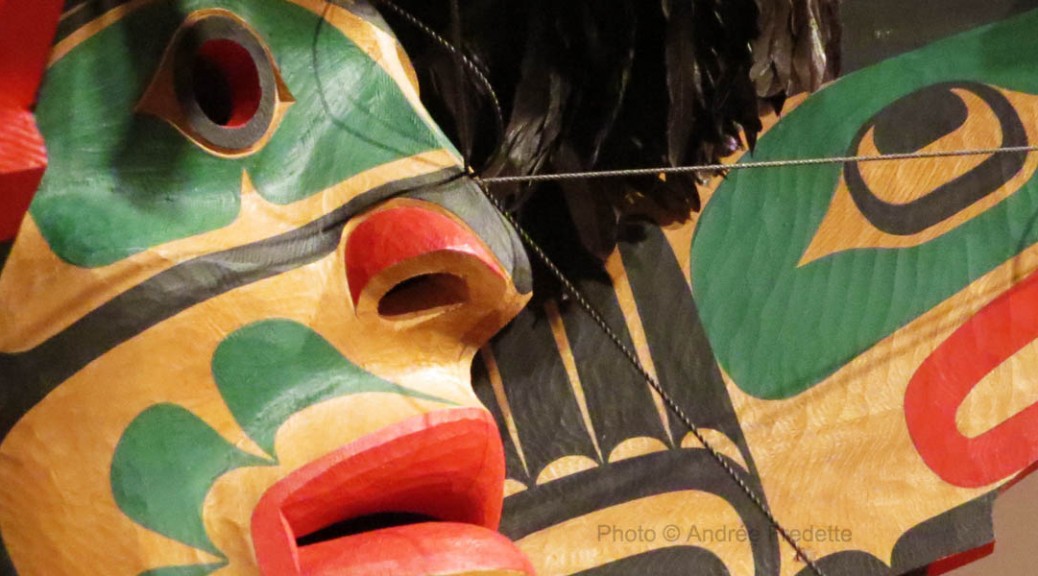
First, a quick description of the very colourful transformation mask pictured above: this is part of a full set of Thunderbird regalia by Calvin Hunt, a Kwakwaka’wakw artist from Fort Rupert (or Tsaxis), on the northern tip of Vancouver Island, BC.
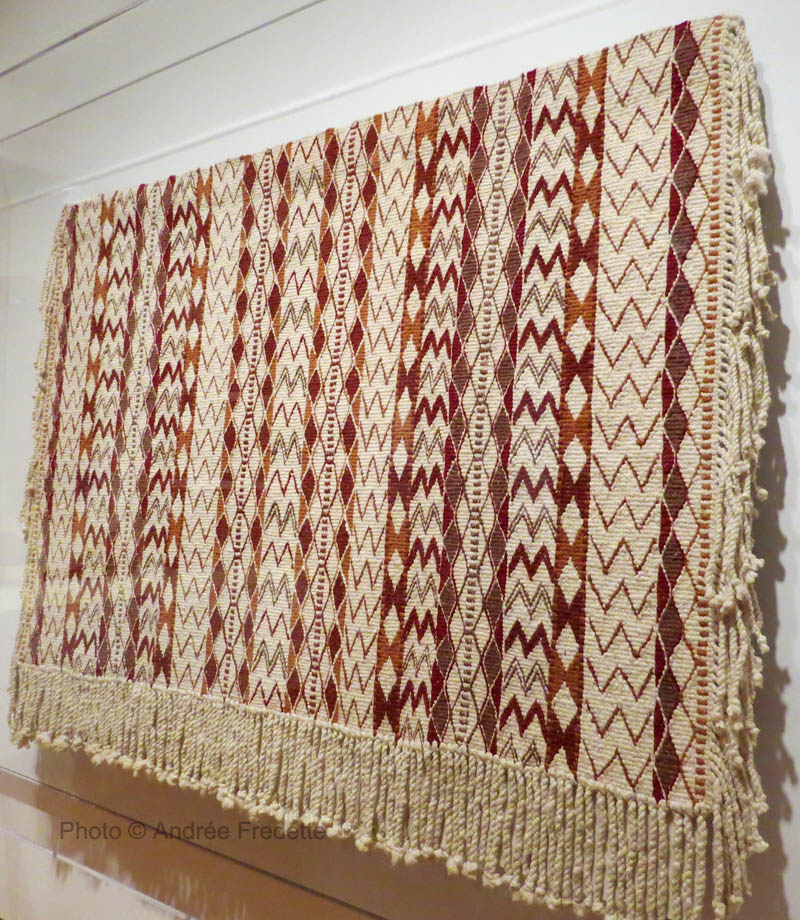
Above, Sacred Change for Each Other, a blanket woven by Susan Pavel. This American artist is an adopted Skohomish. This is the first Salish mountain goat wool robe to be woven in 100 years, and a gift to the museum in 2007. According to the artist:
“This robe or blanket is more than just a garment: it is a feminine entity that has come forth to bring many teaching. The “Sacred change” refers to the revitalization of Coast Salish cultural practices. The wavy lines and zigzags represent the life force, while the dashes are backbones, reminding us to be strong against life’s challenges.”
On to the powerful work of Susan Point, a remarkable Coast Salish artist of the Musqueam band, in Vancouver, BC, who works in red and yellow cedar, as in the piece below, The First People, but also creates commissions in metal, cast concrete, and so on. Check out her public art pieces for the City of Seattle, on her website. And take a look at her serigraphs, at the Spirit Wrestler Gallery website.

I closed in for a detail shot, to show the contrast between areas with deliberate tool marks, and the very smooth finish of the faces.

Then, the piece below stopped me in my tracks. Human Being Neck Ring (Bagwikala), is an accessory for the Kwakwaka’wakw dancer.
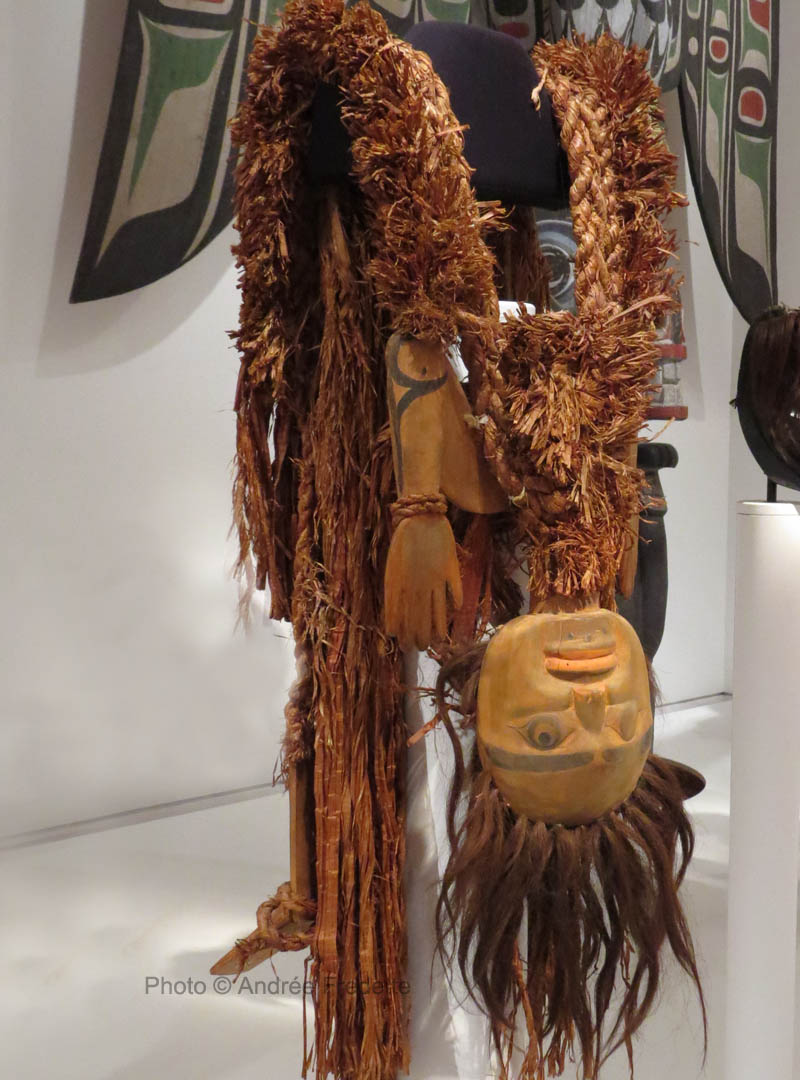
I am very interested in native ceremonial regalia and have admired many masks and accessories for dancers in museums and galleries all over North America. But I have never seen a human being neck ring before. This one was made by Mungo Martin or Charlie James, around 1910. Here is the museum’s description of its meaning:
“Red-dyed cedar bark neck rings are part of the costume of the hamat’sa. As the dancer is progressively tamed, his costume changes from the hemlock bows that he wears when he’s in a wild condition, to red-dyed cedar bark neck rings, arm bands and ankle bands, and eventually to the blanket or robe which he wears in his tame state. Some neck rings have carved figures added. There are only two or three other known examples of neck rings.”
The Hamat’sa is a winter dance, an element of a complex ritual. If you are curious about that ritual, click on this video.
Returning to Calvin Hunt’s dancer’s regalia with which I started the post (mask at the top), the photo below shows the “leggings and toe covers” for the dancer.
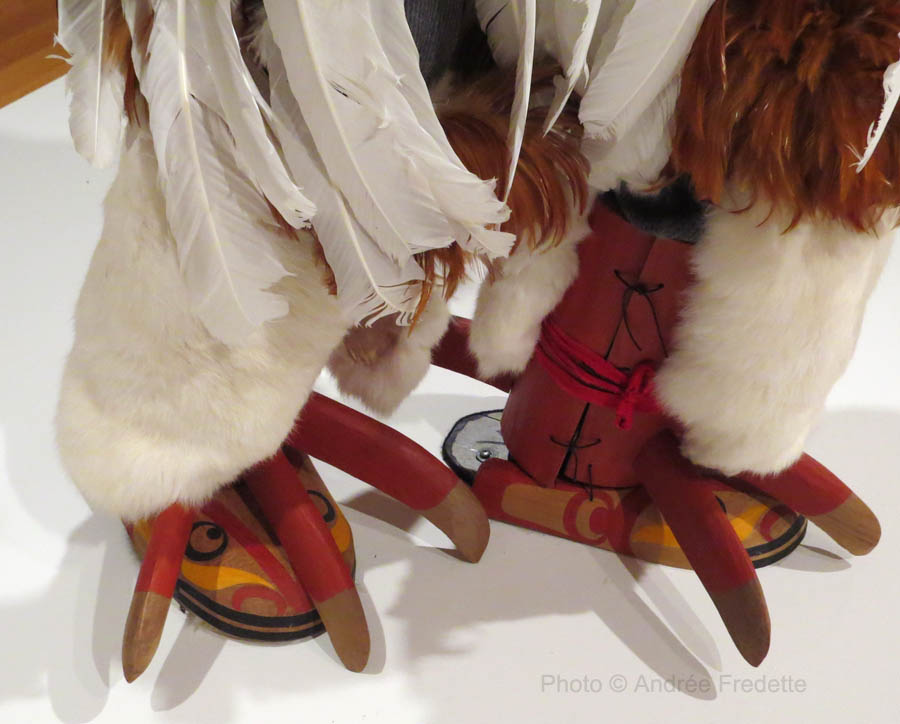
Well, I started this post at the head, with a powerful mask by Calvin Hunt, and am finishing it at the feet of the same regalia. Take a minute to reflect on the meaning of these costumes, the investment in time and effort required to create them, traditionally, for those special occasions. And the imagination and beliefs that powered it all.
My friend Anne Popperwell is an artist whose paintings are sensuous and beautiful.
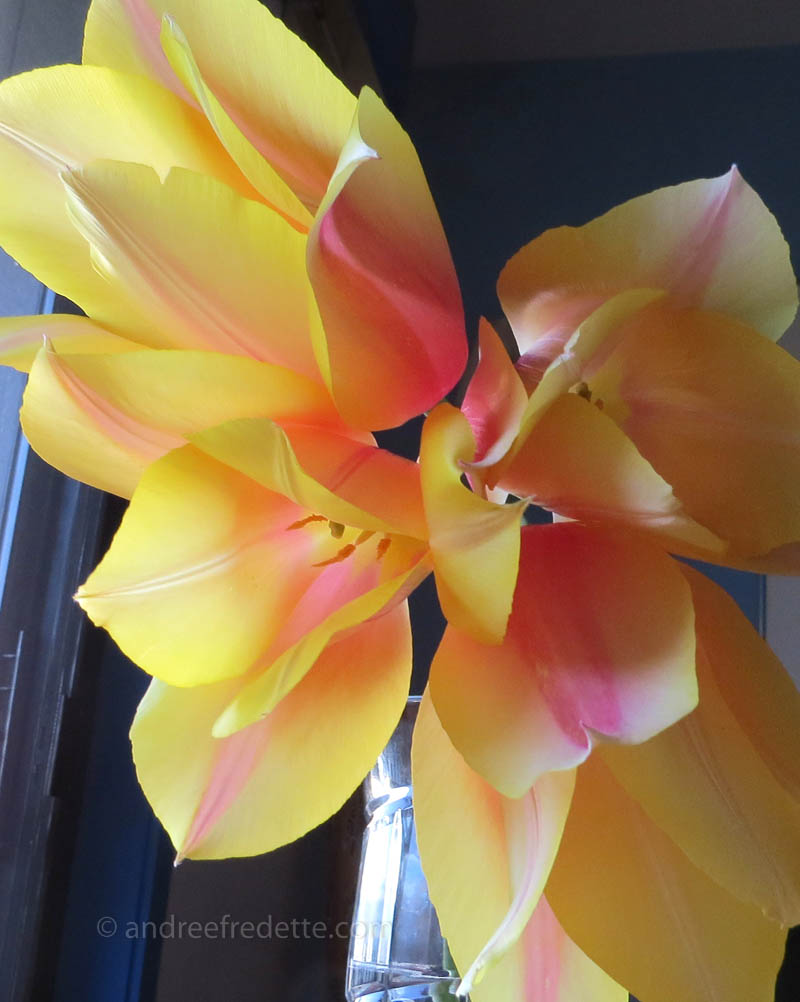
Last week, she brought me these gorgeous “Blushing Beauty” tulips, and explained that she planted the bulbs in her garden because she wanted to paint the flowers, when they bloomed.

I can see why she wanted to paint them! I have never seen a tulip of that size before. They are very large and so elegant.
For several days, Beauty resided on my table.
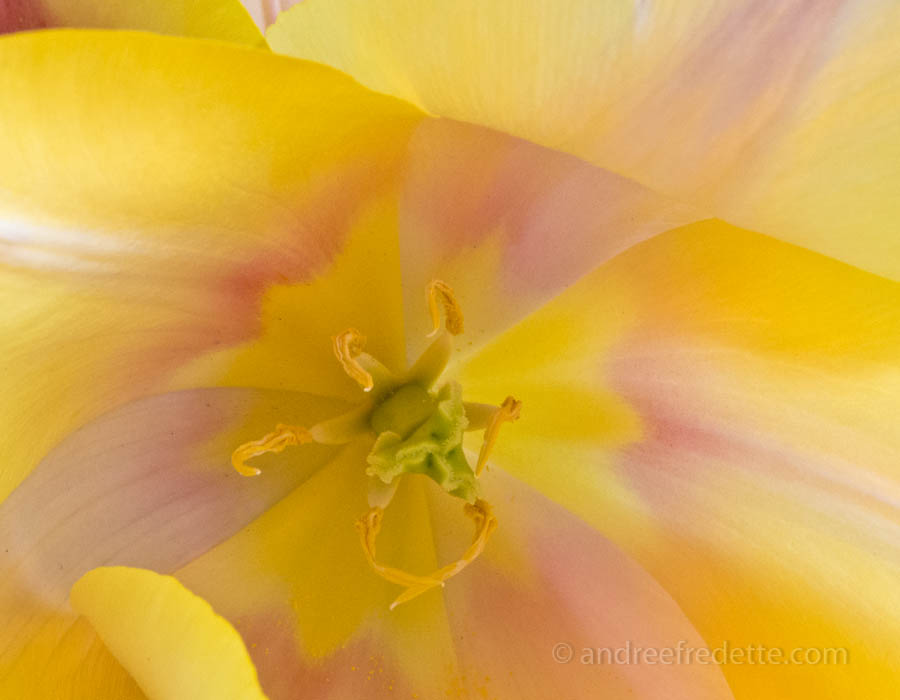
Here is a final close-up…
If you have read the preceding parts of this series (Quilt and Stitch posts: One, Two and Three), you know that I get my ideas from nature. A leaf pattern, a stem, wave action, water… And in this case, water, definitely.

Above, this is another example of my little “corridors” or lanes, first drawn with a straight stitch (well, meandering, but straight, if you get my drift…), and then filled with a motif. I chose the curl to hint at flow, eddies of water. In this case, a piece about the desert in Australia, absent water…

It usually takes me a long time of staring at a quilt top before making a decision on exactly how I will go about texturing it. Sometimes, I will put the finished quilt top away for weeks, before bringing it out, hanging it on my work wall and taking a fresh look at it. In other cases, I know how I will proceed even before finishing the top.
In earlier examples from Quilt and Stitch Ideas, I showed examples of how some quilts “tell me” that the quilting lines or motifs should remain within colour boundaries, within the lines.
But other quilts call for lines that flow across the whole piece. I carry the lines across those boundaries, because it feels right.

This last image shows how much fun it is to compose patterns intuitively. Looks like critters coming out of the ocean, doesn’t it?
Here is the third part of my little series (Quilt and Stitch posts One, and Two) on how I approach the quilting or texturing (or embroidery) of a quilt.
Once I create a top, or quilt surface, I spend a lot of time staring at it, trying to decide how I will add the layer of texture. Where will the lines be most effective? Does it need a lot of texture? Or restraint?

Those are hard decisions. It is sooooo easy to go overboard.

Most of the time, I follow the pieced lines (where two colours meet, for example), and texture between the lines. But there are always exceptions. Rules that need breaking…

And then, there is just the simple joy of meandering on a single piece of fabric, while changing thread colours. I have made discoveries that way! A line of black, for example (on the left, above), serves to highlight its light-coloured neighbour. Relief, in a way… On the right, above, I first placed a little pair of meandering lines in regular thread. Then I turned the piece over, and filled-in that little corridor with a “mossy stitch”, which is a tight figure-eight stitch, using a thick thread wound in my machine bobbin. Time consuming, but very zen.

Finally, another little “sketch”, a practice piece where I tried out various ideas… You can see the evolution of lines, with their accessory and filler motifs.